
Being breached is bad enough for one day. Not being able to recover and having to watch helplessly as the breach is spreading is adding insult to injury. That’s why we wanted to share this recent case with our Breach Brief Weekly subscribers.
We at Granite State InfoSec Consulting LLC usually serve businesses and critical infrastructure organizations to improve their Information Security and Business Continuity. This is where our impact as InfoSec experts with a background as business executives and public servants is highest.
We normally leave the consumer market to other firms with a larger marketing budget.
But a few days ago, a fellow Rotarian reached out in despair after discovering their email had been hacked and not being able to recover on their own, so we volunteered to step in at no charge.
How the Breach Started and Turned into a Lockout
Based on what we saw, the initial compromise was most likely caused by an email password that was leaked as part of one of the recent large-scale breaches with millions of credentials posted on the Dark Web. Worse, the password was not only weak but also reused across more than one account. Proof that these breaches once announced in the media require swift action by users, and that good credential hygiene is key.
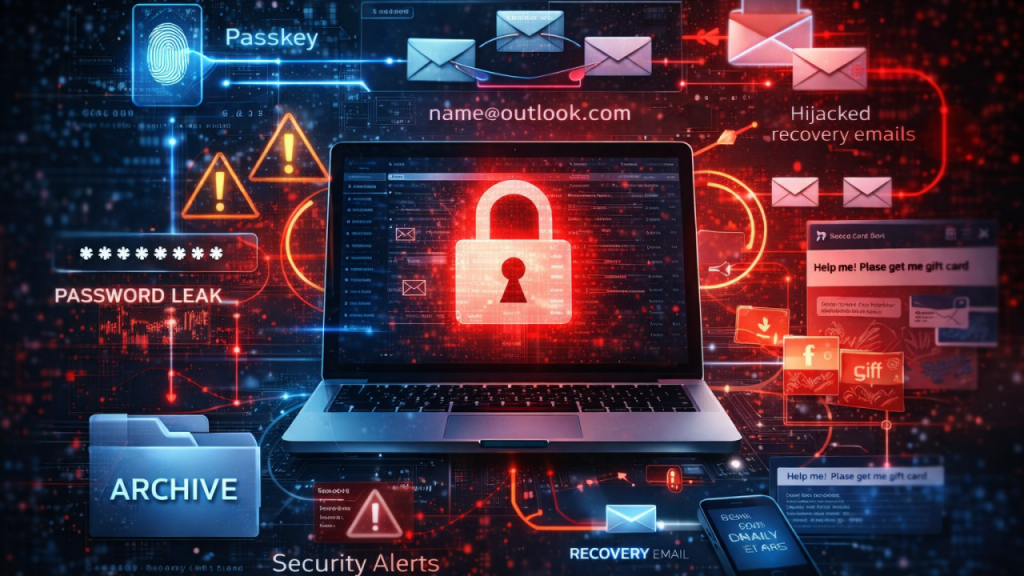
What followed was a textbook example of how a relatively simple breach turns into a prolonged lockout. The person had one Gmail and one Yahoo email account, each configured as the other’s recovery email. Once the attackers gained access to one of them, they effectively controlled both. Every time the rightful owner attempted a password reset, the recovery email landed in the second account, alerting the attackers immediately of a recovery attempt. Within minutes, the password was changed again by the bad guys and access was lost once more.
How The Attack Was Veiled From Discovery And Further Exploited
The attackers immediately created a mail rule that moved all incoming messages from the inbox automatically into a folder misleadingly labeled “Archive.” Security alerts, or warning messages and new emails or replies from contacts simply disappeared from view. From the owner’s perspective, the account looked eerily quiet. In reality, it was being actively used for further fraud attempts.
To reap financial gains from the attack, the threat actors sent a large number of pleading messages out, claiming an accident or other urgent situation and asking for relief by sending virtual gift cards. To make sure responses never reached the real owner, the attackers changed the reply-to address to a newly created Outlook.com account that reused the same name before the @ sign. Unless a recipient looked closely at the domain, the change was easy to miss.
The Extra Backdoor Into The Accounts
There was one more detail to the hack that would have made all recovery efforts void: the attackers set up yet another backstage entryway into the account. They added a passkey.
Yahoo introduced this somewhat new authentication feature into their security landscape rather clumsily. Its settings live outside the usual password and two-factor authentication menu path and are easy to miss unless users specifically know to look for them. Since many private users are not yet familiar with passkeys, they neither use them nor would watch for them in forensic account reviews. We were glad to have noticed.
Getting Control Back and Hardening Security
Only after removing these multiple sneaky entry points, password reset avenues, and shady diversions of email traffic were we able to secure the accounts back to the rightful owner permanently.
Nothing could be done about the fake Outlook.com email address unfortunately, but with the reply-to address removed from outgoing emails, that residual risk for others will fade over time.
Moving on to preventive security measures, we created a new, separate fallback email address and eliminated the interwoven recovery paths between the compromised accounts. Cell phone-based MultiFactor Authentication (MFA) was replaced with an authenticator app to remove the risk of number spoofing or interception. A reputable standalone password manager app and browser plugin was installed, eliminating the not very secure browser-based “Remember Password” feature, and all credentials were replaced with long, unique, and complex passwords.
In the end, the most important outcome was not technical, but rather the moment things went quiet again. Emails landed where they should, and password resets held. That sense of safety is easy to underestimate until it is gone.
Why This Matters Beyond One Inbox
What made this incident so exhausting was not the initial breach. It was having to discover each additional alteration of the accounts under stress, one setting at a time, while damage was already being done. Every fix depended on knowing where to look, what mattered, and what had silently been changed.
To draw a wider circle for our newsletter’s audience: This is the story for only one individual. In organizations such as businesses or critical infrastructure, a similar compromising situation can instantly snowball into dozens, hundreds, or many thousands identical cases. The impact is not only maddening, but at times catastrophic and debilitating. Many organizations do not survive a large-scale breach.
Preventing that cannot be left to chance or individual awareness. A comprehensive, thought-out, and broadscale proactive approach is needed. This is precisely where an Information Security Management System like ISO27001, TISAX®, etc. is showing its strengths. It ensures that basic controls like credential hygiene, recovery paths, authentication methods, and visibility are defined, enforced, and reviewed for everyone, not just the few people who happen to know better.
This story started with a single email account. The attackers were not special, no sophisticated Hollywood hackers.
The relief at the end was no black magic either. It came simply from structure replacing improvisation. That is the real difference.
#TISAX #ISMS #InfoSec #InformationSecurity #CyberSecurity #ISO27001 #RiskManagement #Automotive #GSInfoSec #NIST #CMMC #CRA #CyberResilience