
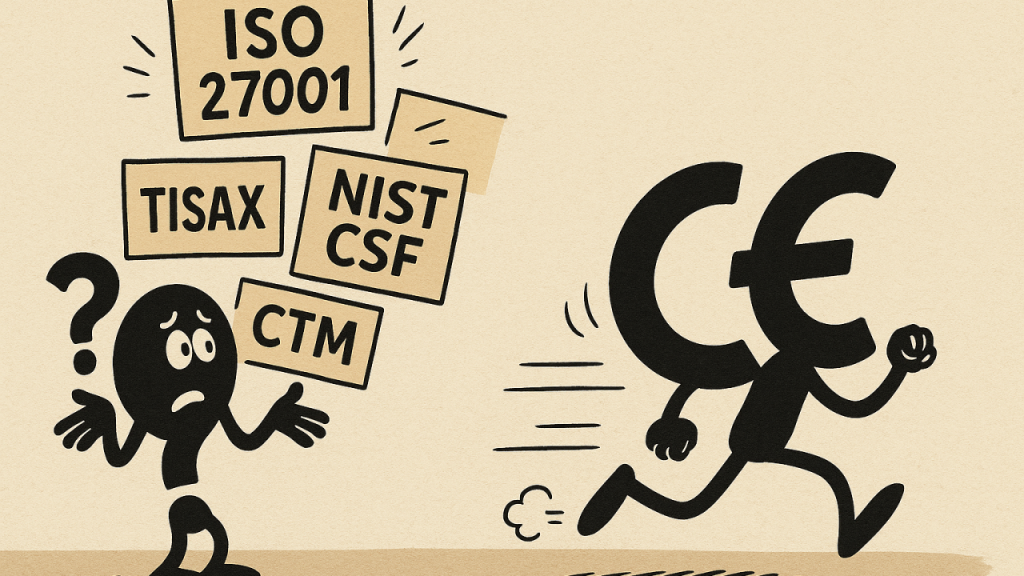
So, you have been following and sharing Breach Brief Weekly for a while now (thank you!). You heard us talking about ISO 27001, TISAX®, NIST, CSF, and all the other Information Security needs your organization should have high on their list, either to protect your own Business Continuity, or to satisfy your customers.
Buckle up! Because there is another huge compliance wave coming with a vengeance, and it’s coming very, very fast: the European Union Cyber Resilience Act (CRA).
Think Sauron’s One Ring, only in Cybersecurity:
One Ring to rule them all, One Ring to find them, One Ring to bring them all, and in the [compliance] bind them.
I know, a bit nerdy, but hear me out, because this might not yet be on your radar, and if you deliver products to Europe, you’ll really want to read on.
The Optional is Becoming Law
In Europe, Cybersecurity and Information Security are about to become a legal product requirement. Not a self-protecting measure like ISO27001, nor a marketable necessity like TISAX®. A legal mandate, monitored by authorities, with a deadline and rather stiff penalties.
Starting December 2027, every product carrying the CE mark – from a basic controller chip to a full automation system with all its affected components – must comply with the EU Cyber Resilience Act (CRA).
This law expands CE’s mandatory “Product Safety” to include Cyber Safety, forcing manufacturers to prove that connected devices and those used within their product are secure by design and secure throughout their lifecycle.
What’s Changing
The CE mark – mandatory for selling most finished products in the EU – used to mean your product was safe to use, touch, install, and operate.
Now, it must also be safe to connect.
If your product includes digital or networked components, like controllers, PLCs, drives, sensors, gateways, programmable chips, firmwares, software tools, it falls under the CRA.
Compliance becomes a legal prerequisite for selling in the EU. You don’t have a choice if you want to continue market your product to the EU.
The CRA in a Nutshell
Manufacturers must now:
- Perform and record Cyber Risk Assessments during design and development
- Maintain a Software Bill of Materials (“SBOM”) listing all affected components and dependencies
- Monitor vulnerabilities for the defined life cycle of the product
- Patch affected products
- Notify all customers about known security gaps and available mitigations
- Deliver security updates for up to 10 years
- Maintain technical documentation and evidence of conformity
Again: That’s not a recommendation. It’s the new definition of CE compliance.
From Engineering to Cyber Logistics
Imagine a U.S. motor drive manufacturer selling VFDs into Germany. The firmware includes an open-source Modbus library and a third-party TCP/IP stack.
Such manufacturer now is mandated to comply with those CRA requirements. That’s not an Aftermarket courtesy – it’s a legal duty under the CRA. Cybersecurity now reaches into engineering, production, customer service, and warranty management.
Why This Matters for U.S. and EU Manufacturers
- EU producers must embed CRA compliance into their CE-marking process by 2027.
- U.S. exporters selling connected devices into the EU will need to meet the same requirements – or lose access to the market.
- Suppliers and OEMs alike will face new expectations for documentation, traceability, and post-market vulnerability management.
Anyone who’s familiar with engineering, supply chain, production logistics, commissioning and warranty processes, supplier RMAs (Return Material Authorizations), product and component serial number tracking, etc. knows the complexity of maintaining accurate records of which component is present in what product at any given time throughout the product lifecycle.
Add to that now the need to also track software, firmware, and parameterization versions throughout the product lifecycle.
Only painstakingly well-organized processes executed with 100% precision on a daily basis will be able to handle these requirements.
It’s a massive operational shift, but also a tremendous opportunity for manufacturers who prepare early. And it affects the complete lifecycle management of a product. If you always wanted to pursue component and software traceability in your organization, now is the time.
US Market not quite as affected, yet
While the EU moves toward a unified framework under the Cyber Resilience Act, the United States’ legislation hasn’t quite pushed as hard yet. American Cybersecurity requirements are scattered across sector-specific rules and voluntary frameworks such as NIST, CISA directives, and various state laws.
The only step in a similar direction so far is the U.S. Cyber Trust Mark – a voluntary labeling program led by the FCC and NIST that signals baseline cybersecurity specifically for consumer IoT devices like smart appliances or home automation products. It’s a start, but far narrower in scope than the CRA, which will apply to all products with digital elements placed on the EU market. We actually covered the CTM on our website blog some time ago: Is your robotic vacuum or fridge a security threat? You bet they are.
Still, the direction of travel is clear. Between the White House National Cybersecurity Strategy, ongoing CISA and NIST initiatives, and increasing pressure from global trade alignment, it’s no longer a question of if similar product-level resilience rules will reach the U.S.- but when. It also is a simple necessity in response to the real and present threat landscape.
Act Now. 2025 Is the Planning Window
The CRA isn’t optional. It’s enforceable. But compliance builds on familiar ground: ISO 27001, TISAX®, and NIST CSF already define many of the necessary processes.
Start now:
- Map your product’s firmware and software components
- Adapt your ERP/CRM/CMMS capabilities to handle component and product serialization
- Build your SBOM maintenance process discipline
- Create a vulnerability-handling process. incl. customer notification tracking
- Train your engineering. logistics, and service teams
- Align your ISMS with your CE procedures
By 2027, the CE label will double as your product’s Cybersecurity passport. To earn it, you’ll need to prove that your product’s security doesn’t end when it ships.
Because in the era of the Cyber Resilience Act, security is not declared – it’s designed into the product lifecycle.
#CyberResilienceAct #CRA #CEmarking #InformationSecurity #CyberSecurity #Manufacturing #Automation #ISO27001 #TISAX #NIST #SBOM #GSIC